Lemma · Tables
The list your whole team keeps current.
Deals, follow-ups, customer files: one row each, in a real table. Your teammate updates rows as it works; your people see them as a board or a checklist and tick them off.
 Deals
Deals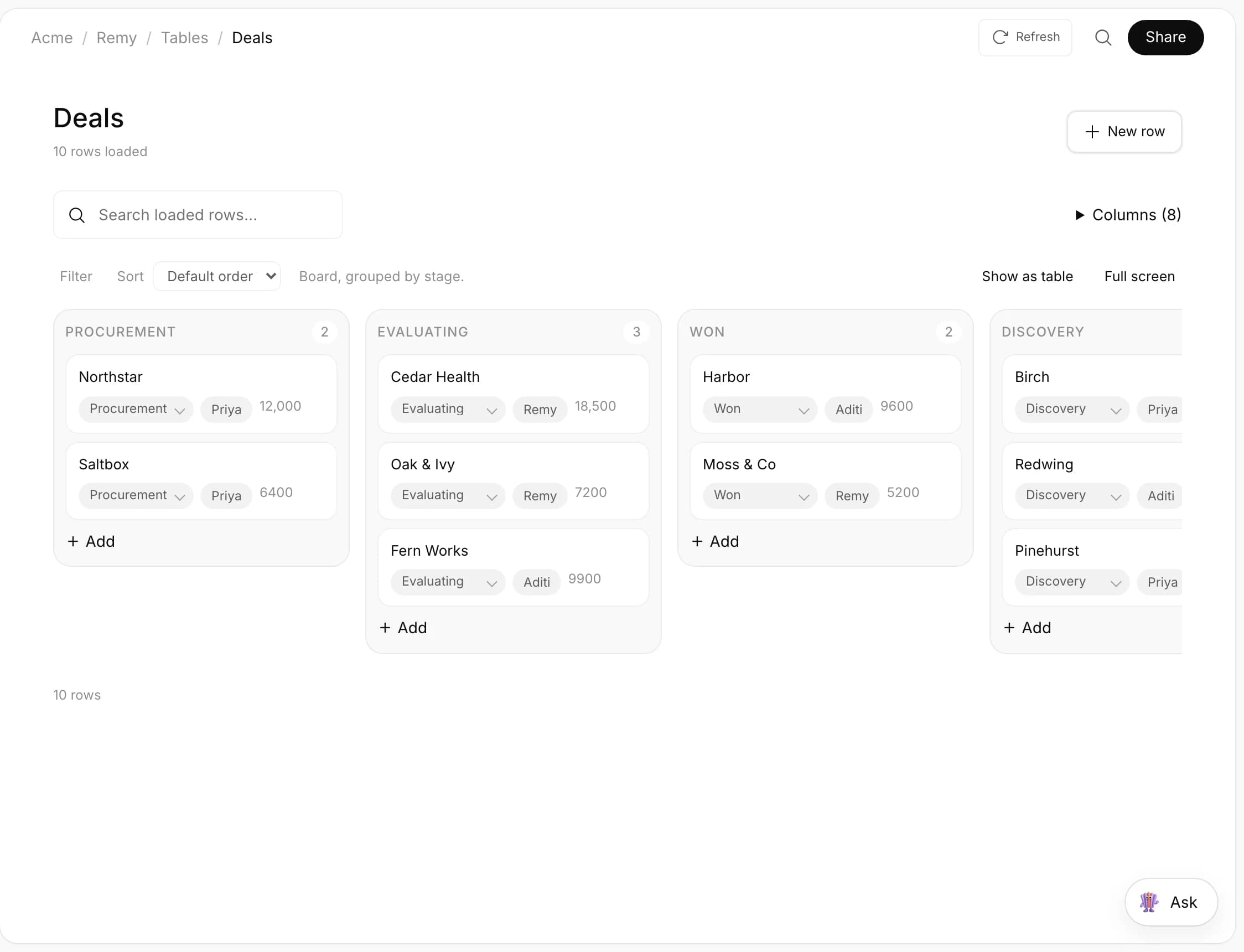
Remy’s deals, piled by stage.
What a table is
One row for each thing the work is about.
Each deal, follow-up or customer file gets a row, and each fact a column. What your teammate learns lands in a row, where the next question, page or workflow finds it. You don’t design it: say what to track, and it sets up the columns.
One sentence in, a table out.
Remy /TablesTables
NewNo tables yet
Tables keep what your team tracks, one row each; Remy sets them up and fills them in.
Ask Remy to set one upTasksContactsName
What should Remy work on?
Send a message to start a new conversation.
Set up a table to track what each buyer is waiting on us for, with a due date.
Remy
Working2 stepsMade Follow Ups, with the three I know about so far.
| follow_up | done | due |
|---|---|---|
| Northstar: security overview to Anita | false | 2026-10-02 |
| Saltbox: chase the order form | false | 2026-10-03 |
| Oak & Ivy: SSO answer for Lena | false | 2026-10-04 |
Views that choose themselves
Stages become a board. Due dates become a checklist.
The table reads its own values and draws the view that fits, then says why. Show as table is always one click away.
Due dates and done boxes: a checklist.
Remy / Tables /Follow UpsFollow Ups
6 rows loaded
4 left of 6+ Add
- BoardRepeating stages, a name on every row.
- ChecklistDue dates and done boxes, soonest first.
- TimelineNamed things that already happened.
- ChartOnly dates and numbers.
- Reading viewLong writing a cell would cut off.
- GridEverything else, and any very large table.
Kept current
Whoever hears the news moves the row.
Saltbox signs. Priya tells your teammate in Slack, and it moves the deal to Won with Priya’s access and no more. Or she changes the stage herself in two clicks.
One message, and the deal moves to Won.
Remy /Tables /DealsRefreshShareDeals
10 rows loaded
Procurement21
Evaluating33
Won23
Discovery33
RemyOn DealsSaltbox signed the order form.
RemyMoved Saltbox to Won and ticked off the chase.
Ask about this table
Questions about the rows, or changes to make.
- Move itEach card’s stage is a picker; a refused change bounces back with the reason.
- Tick itDone boxes are real. Ticked rows sink; late ones get flagged.
- Edit itForms are built from the columns and checked before saving.
Each person, their rows
Everyone sees their own rows, and Postgres enforces it.
Give rows an owner and row-level security does the rest: Priya and Aditi open the same Follow Ups and each sees theirs. When Priya asks in Slack, your teammate reads the table as Priya.
Same table, two people, two lists.
Remy’s space· TablesPPriya
AAditi
1 left of 3
- Fern Works: case studyin 4 days
- Harbor: intro Mira to Junetoday
- Redwing: walkthrough videotomorrow
2 left of 2
- Northstar: security overview to Anitatomorrow
- Saltbox: chase the order formin 2 days

Checked by Postgres on every read and write.Admins of Remy’s space see every row.
Ask the table
Ask a question, get rows back.
Every table has its own chat. Ask which open deals are over 10,000 and your teammate runs one read-only query, then answers with the rows, the total and the query itself, so you can check it.
45,500 across three deals, query shown.
Remy /Tables /DealsRefreshShareDeals
10 rows loaded
Search loaded rows…Procurement2
Evaluating3
Won2
Discovery3
10 rows
RemyOn DealsWhich open deals are over 10,000, and what do they add up to?
Remy45,500 across three deals.
SELECT company, stage, value FROM deals WHERE stage <> 'Won' AND value > 10000 ORDER BY value DESC
| company | stage | value |
|---|---|---|
| Cedar Health | Evaluating | 18500 |
| Redwing | Discovery | 15000 |
| Northstar | Procurement | 12000 |
Ask about this table
Questions about the rows, or changes to make.
Rows start work
A new row can start a workflow.
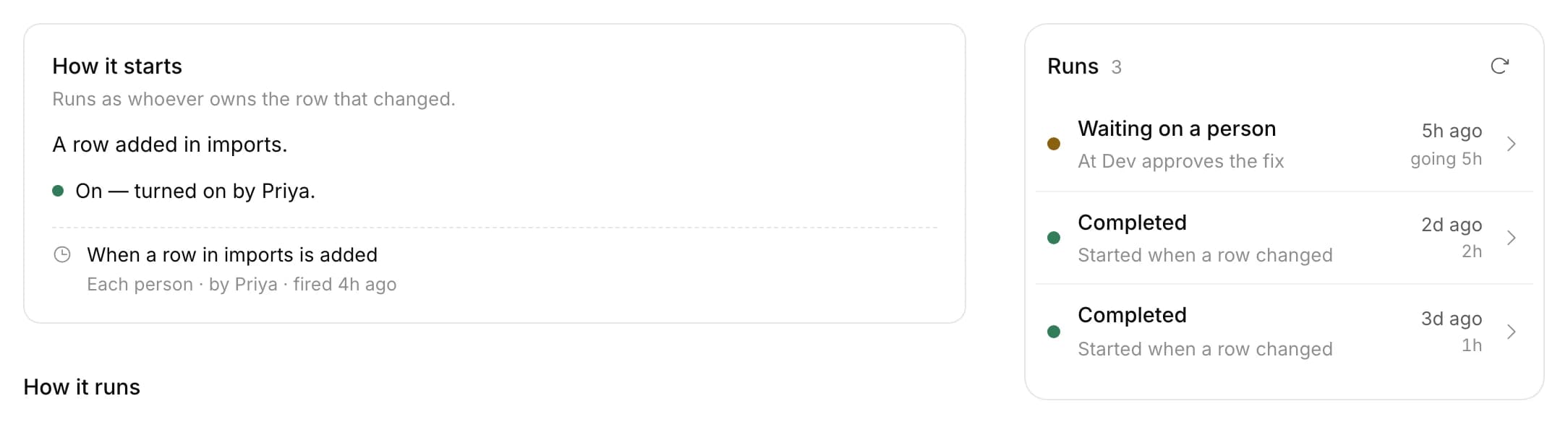
A customer file added to imports starts the First import check on its own. Any table can trigger work: on every new row, or only when a deal’s stage changes to Won.
A row added in imports starts the check.
Underneath
Real Postgres, shared by pages, apps and Claude.
The same rows, under the same access rules, wherever they’re read.
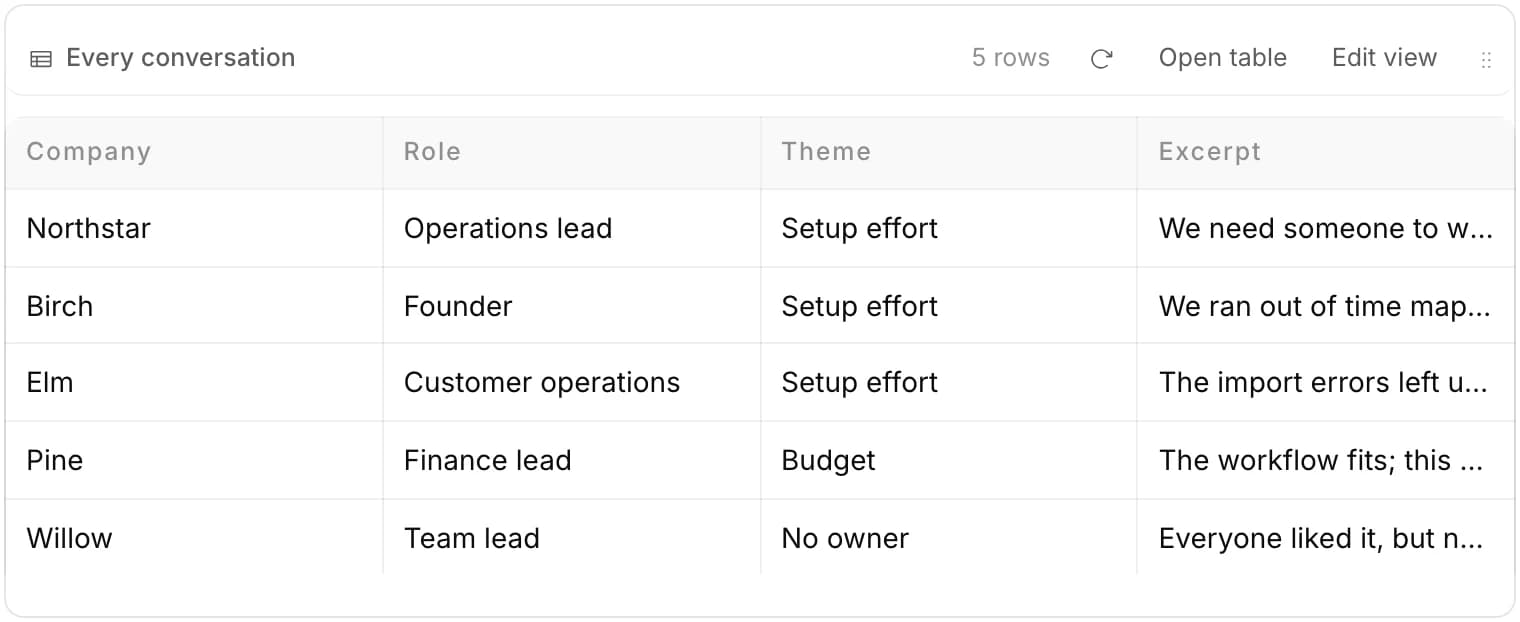
The interviews table, inside a page.
- Typed columnsText, numbers, dates, choices, people and links; required or unique.
- Read-only SQLJoins and totals, run as you, never past row security.
- Every row has a pageWith links both ways, kept for you.
- In pages and appsPages show the same rows; apps read and write them.
- From Claude or ChatGPTQuery and write rows over MCP, as you.
- From a spreadsheetLoad a CSV with the Lemma CLI. No formulas.
The rest of its space
Every part of the job, in one place.
What lives in a sheet nobody trusts?
Say what to track. Your teammate sets up the table and keeps it current.